


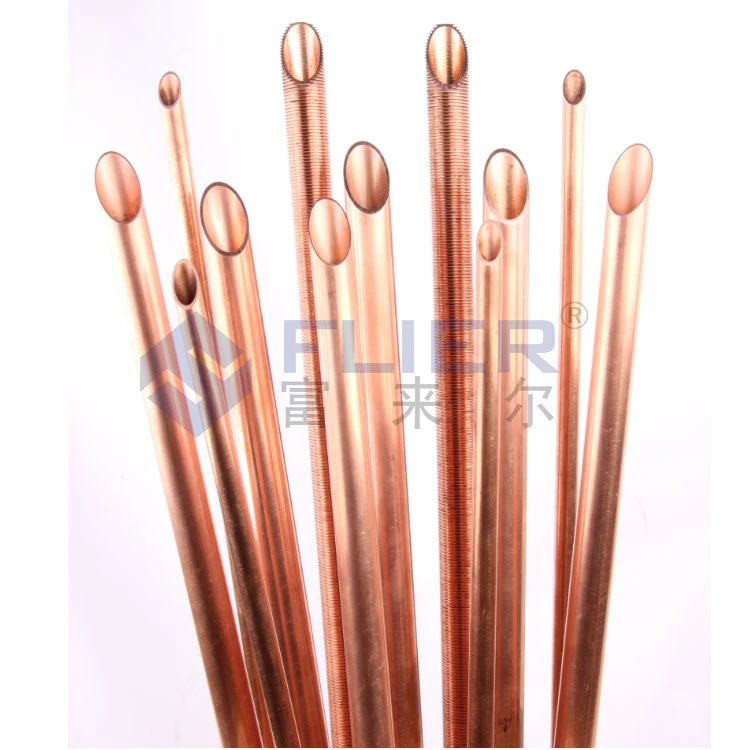


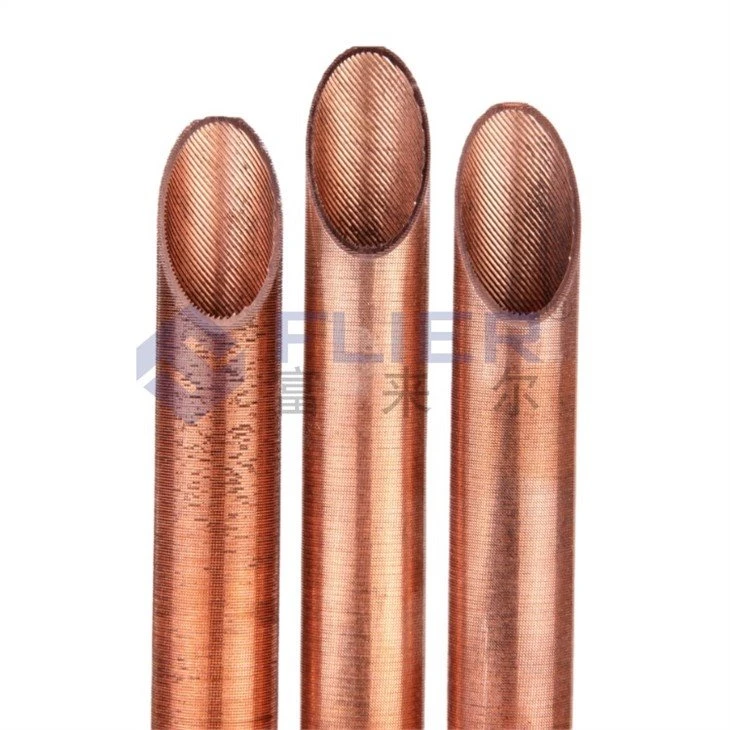
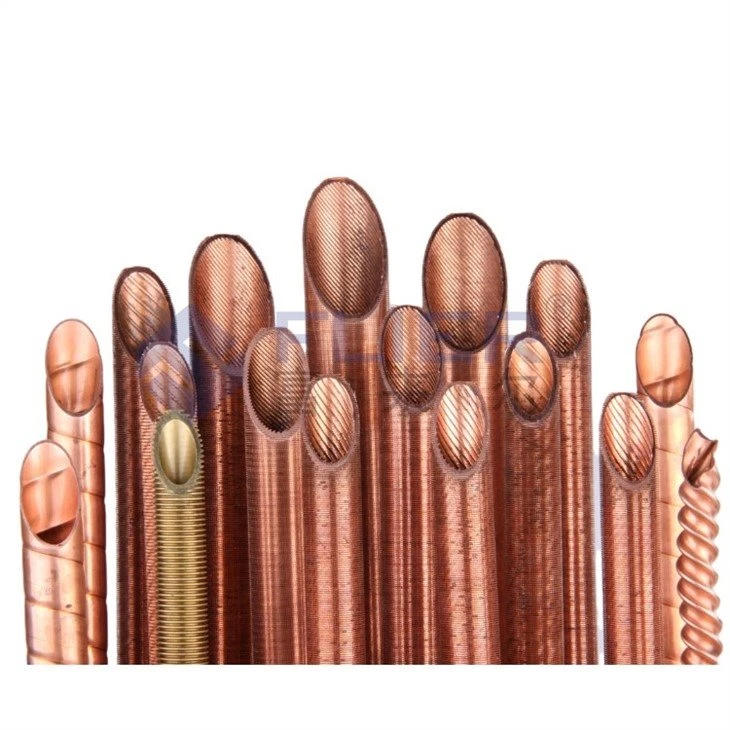

Copper Tube for Heat Pump Condenser
Copper tube is also called red copper tube. A kind of non-ferrous metal pipe, which is pressed and drawn seamless pipe. Copper pipe has the characteristics of good electrical conductivity and thermal conductivity. It is the main material for electrical and heat-dissipating accessories of electronic products. It has become the first choice for modern contractors to install water pipes, heating and cooling pipes in all residential commercial buildings. Copper pipes have strong corrosion resistance, are not easy to oxidize, and are not easy to chemically react with some liquid substances, and are easy to bend and shape.
Copper pipe for cooling of heat pump condenser
Process classification
Bellows

Bellows, also known as large pitch pipes, are mainly used in water coolers for liquid-liquid exchange. The characteristic of the bellows is that the outer surface has a spiral corrugation with a large pitch, and the inner surface can also be designed and processed with internal threads. Therefore, during heat exchange, due to the enhanced effect of turbulence, high heat transfer efficiency can be obtained.
Spiral tube

Spiral tube is also called twist tube and multi-head tube. It is suitable for liquid-liquid heat exchange, gas-gas heat exchange, evaporator, condenser, high-viscosity fluid heat exchange and other tube applications. Some of the products with specifications are also suitable for double-pipe heat exchangers.
The spiral tube is made by twisting a smooth tube. It has a deep concave spiral groove structure, so it has higher thermal conductivity than other tubes. At the same time, due to its excellent flexing performance, it can be used under tight installation conditions.
Strengthened condensing tube

Enhanced condensing tubes are mainly used in centrifugal chillers, chillers and shell-and-tube heat exchangers under small temperature differences.
For external surface condensation, the enhanced condenser tube has improved the outer fin type of the tube, making the outer fin distance of the tube smaller and has a sharp serrated cut, which is a new type of heat exchange tube. Therefore, compared with other tube types, it not only simply increases the heat transfer area outside the tube, but also divides the refrigerant into very thin processes when it passes through. The friction between the layers generates turbulence and changes the flow of the refrigerant. So it has a high heat transfer efficiency. In addition, due to its special three-dimensional fin-shaped feature, when the refrigerant flows along the longitudinal direction of the tube, the pressure loss can be significantly reduced. The inner surface of the tube can also be machined with threaded grooves to further increase the heat exchange area and turbulence effect of the inner surface, and enhance the comprehensive heat exchange capacity. The new tube type of the gun enables the volume and weight of the heat exchanger to be correspondingly reduced, which meets the requirements of energy saving and cost reduction.
This tube type is also suitable for high-viscosity refrigerants, and it is also effective when used in double-pipe heat exchangers.
Enhanced evaporating tube

Enhanced evaporator tubes are mainly used in centrifugal chillers, chillers, and shell-and-tube heat exchangers under small temperature differences.
The enhanced evaporator tube is a new type of heat exchange tube with strong vaporization and boiling on the outer surface. Its excellent thermal conductivity is derived from a unique microporous structure, and the optimized microporous structure is not just a simple The heat exchange area is enhanced, and a large number of vaporization cores required for evaporative heat exchange are increased, which changes the evaporative flow mode of the refrigerant and helps to remove impurities and reduce fouling, reduce the heat resistance outside the tube, and significantly improve the heat exchange outside the tube Efficiency: The inner surface of the tube is also processed with spiral grooves to further increase the heat exchange area and turbulence of the inner surface, and reduce the thermal resistance in the tube. The improvement of the heat exchange efficiency inside and outside the tube greatly promotes the comprehensive heat exchange capacity of the tube type, and the volume and weight of the heat exchanger can be reduced accordingly to meet the requirements of energy saving and cost reduction.
Internal thread pipe

The internally threaded tube is also called dry steam tube, internal rib tube or internal fin tube. In central air conditioners, it is mainly used in dry evaporators. During heat exchange, the water outside the tube is cooled by the evaporating and expanding refrigerant in the tube; it is also used in domestic and commercial air-conditioning heat exchangers or in high-heat tubes.
The inner surface of the internally threaded tube per unit length is 1.5-2 times that of the ordinary smooth copper tube, and its heat transfer coefficient is 1.5-2.4 times that of the smooth copper tube of the same specification, while the flow resistance to the carrier is only increased by 3-5%. Energy saving is 20-35%, and the weight of the refrigeration air conditioner is reduced by 10-25%.
To facilitate installation, internally threaded pipes are usually delivered in straight strips.
Low fin tube

Low fin tubes are mainly used in condensers and evaporators in air-conditioning and refrigeration equipment, absorption chillers, oil coolers and various other heat exchangers; used in condensers and heat exchangers in thermal power plants and nuclear power plants Evaporators, condensers and evaporators in marine exchangers; used in gas turbine units and air coolers, diesel coolers, secondary coolers and various heat exchangers in waste heat recovery systems used in the petroleum industry, and used in the chemical industry Dryer and heater.
The low-fin tube is formed by rolling a continuous spiral fin on a smooth tube. Compared with the light pipe, it has a larger external surface area and higher heat transfer performance, so it is widely used in various heat exchange and conduction occasions.
Product display


What are the functions and types of condensers?
The condenser is a heat exchange device in the refrigeration process. Its function is to cool and release the high-temperature and high-pressure gaseous refrigerant discharged from the compressor into a liquid refrigerant, and transfer the heat to water or air.
The condenser needs to have a certain cooling surface area and high heat transfer efficiency, and can withstand certain pressure and corrosion resistance.
The commonly used condensers for air conditioning can include water-cooled condensers, air-cooled condensers, and evaporative (or sprinkler) condensers.

Hot Tags: copper tube for heat pump condenser, China, suppliers, manufacturers, customized, cheap, used, high quality, Copper Tube For Heat Pump Condenser, Copper Pipe For Refrigeration, TEIKOKU Canned Pump
Previous
No InformationYou Might Also Like


Send Inquiry